
From the Sensex constituents, Adani Ports, Tata Steel, Kotak Mahindra Bank, UltraTech Cement, Bajaj Finserv and Titan were among the biggest gainers. In contrast, Power Grid, Trent, NTPC, Maruti, HCL Tech and Bharat Electronics were among the laggards.
We, Indians, forgot that for Pakistan, Kashmir dispute and blood feud with India is the raison detre for its existence. It is also the excuse with which the Pak army keeps its grip over the state. Peace in Kashmir and between India and Pakistan is against the interests of the Pak army, points out Colonel Anil A Athale (Retd).

Both sides have now revealed a preference for escalation over strategic defeat, and each new provocation narrows the space for the next pause. The Touska seizure, Iran's refusal to negotiate under blockade, Israel's strikes on Iranian oil infrastructure -- all of these add up to an increasingly untenable situation. This makes the wild card -- Trump and his motormouth -- more consequential than ever, notes Prem Panicker in his must read blog on the Iran War.
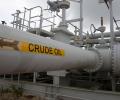
MEA spokesperson Randhir Jaiswal said India's energy decisions are guided by national interest.

This weekend, Donald Trump has begun to say the quiet part out loud -- that he wants to take control of Iran's oil, a formulation more in line with his robber-baron style of international relations.

'Our diplomacy should have been focused on preventing war and avoiding the inevitable disruptions it would cause, posing a real risk to India's growth story,' asserts former foreign secretary Shyam Saran.
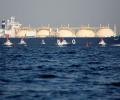
Analysts predict India will face oil price volatility and macroeconomic effects due to the escalating Iran crisis, though the country's oil supply chain is not yet structurally insecure.

Trump seems to have estimated that Ghalibaf is a pragmatic politician who is receptive to close relations with the US and is enthusiastic about fostering business and economic ties in particular, points out Ambassador M K Bhadrakumar.

A new study by AI firm Anthropic reveals that while AI hasn't caused widespread unemployment, it has slowed hiring for younger workers in AI-exposed roles. The study also highlights the gap between AI's theoretical capabilities and actual deployment, and the ongoing conflict between Anthropic and the US government over AI weaponisation.

For weeks, the war skirted the edge of catastrophe without tipping over. Missiles flew, there was much destruction, commanders were assassinated, cities across the Gulf and even in Israel struggled to absorb the shock. But one line held: Energy infrastructure, the arteries of the global economy, remained largely untouched. That is no longer true. Prem Panicker continues his must read daily blog on the Gulf War.
Following a joint attack by the US and Israel on Iran, India is calling for restraint and de-escalation to avoid further military confrontation in the Middle East.

United States President Donald Trump on Friday withdrew the invitation extended to Canada to join the Board of Peace.

If the Iranian regime needs to be punished for promoting quasi-terrorist outfits like Hezbollah and Hamas, then what about Pakistan which has spent decades exporting terror around the world, killing thousands, particularly in Afghanistan and India? asks M R Narayan Swamy.

'Oil is still well below its all-time highs, and the world is gradually running out of known reserves.'

Alliances fight wars effectively only when they share an endgame. If Israel acted without US knowledge, then the military alliance is operating without real coordination at the level of strategic targeting. Neither picture is reassuring in a war that is no longer regional in its consequences. Prem Panicker continues his must read daily blog on the Gulf War.

When missiles fly in this region, they are never just aimed at military targets.

'What we have yet to see on either the US or the Iranian side is willingness to compromise on their ultimate demands and the flexibility to reach an agreement to end the war.

India and Israel have elevated their relationship to a special strategic partnership, focusing on enhanced cooperation in trade, technology, and defense, while also addressing regional peace initiatives.

Talmiz Ahmad is a former Indian ambassador to Saudi Arabia, Oman and the UAE. In an interview with Aditi Phadnis, he says the disequilibrium in Iraq will continue to prevail. Ahmad also says there are indications that the US is now anxious to avoid intervening militarily in West Asia, and that this is the appropriate moment for Asia to assume responsibility for its own security. Edited excerpts:

'Was the five-day pause ever meant to hold, or was it simply another instrument of signaling, of positioning, of buying time in a war where even the pauses are tactical?' asks Prem Panicker in his must read daily blog on the Gulf War.

The delegations from the US and Iran head to Islamabad on Friday, carrying a ceasefire that is already fraying, a Strait that is technically open and practically closed, and a negotiating agenda that would challenge even parties actually negotiating in good faith, which these groups are not. Prem Panicker continues his must read blog on the Iran War.

When everyone has footage and no one can verify it, the loudest voice wins, notes Prem Panicker who begins a daily blog on the War in the Middle East.

Iran launched retaliatory military strikes targeting Israel and American military bases across the region, including in Qatar, the United Arab Emirates, Kuwait, Bahrain and Jordan.
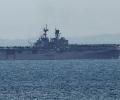
Although extensive air attacks have been carried out to destroy most of Iran's defence capabilities, the latter's resilience and sustenance during the war clearly indicate that the US landing force would encounter severe resistance in the operation, explains Commodore Venugopal Vengalil (retd).

India should resist knee-jerk responses to tariff volatility in the US and instead use the current geopolitical churn to build manufacturing scale at home, former G20 Sherpa and former chief executive officer of NITI Aayog Amitabh Kant said on Wednesday.

'Despite the large number of missiles and drones we have already launched, we still possess reserves and missile cities whose doors have not yet been opened,' says Iran's Consul-General Saeid Reza Mosayeb Motlagh.

The 'rescue' operation occurred within kilometres of Iran's underground tunnel complex at Isfahan, assessed by the IAEA and US intelligence as holding a substantial portion of the country's 60 per cent enriched uranium stockpile. Retired senior US military officers have highlighted that the mission's footprint -- hundreds of special operators, multiple heavy-lift aircraft deep inside Iran -- appears outsized for recovering a single airman. Prem Panicker continues his must read blog on the Iran War.

'We are profoundly energy-dependent on the Gulf. That dependency must now be redirected towards the United States, because we require American permission to procure oil.' 'We additionally require Iranian permission to acquire oil from that source. So India now has to seek two separate permissions merely to secure its energy supply.' 'Should we be compelled to source from America, or from Venezuela -- which is, in effect, American-controlled supply -- that will inevitably carry a price premium, an elevated shipping cost, and a considerably extended delivery timeline, given the distances involved.'

'Without ground troops the US will not be able to oust the Iranian Islamic regime. Political change does not happen just by using bombs or planes.'

Sonia Gandhi has criticised the Modi government's silence on the assassination of Iran's Supreme Leader, arguing it raises doubts about India's foreign policy direction and credibility.

Iran is fighting a different war: Older, slower, and in some ways more dangerous. Iran doesn't need to shoot down an F/A-18. It only needs to make the Strait of Hormuz feel dangerous long enough for insurance markets, shipping companies, and oil futures traders to do the rest. Prem Panicker continues his must-read daily blog on the war in the Middle East.

The question is no longer whether the war will expand. It has. The next few days will tell us whether the war stabilises around Hormuz or whether the Strait itself becomes the trigger for a far larger rupture. What to watch for over the next 48 hours is simple: Any move by the US toward direct naval control of the Strait; any credible Iranian attempt to disrupt or mine shipping lanes and, critically, whether energy infrastructure in the Gulf continues to be targeted.If those lines are crossed in tandem, the war will no longer be containable within the region.

The pause gives the US time to breathe, to regroup, to move its expeditionary force into position without risk of interception along the way. It gives Iran nothing -- on the ground, attacks against its infrastructure continue apace. Prem Panicker in his must read daily blog on the Gulf War.
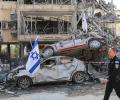
Iran fired around 200 ballistic missiles and drones at Israel on Saturday, June 14, 2025, causing widespread damage in communities in north Israel, killing three people and injuring dozens.

Israel has for more than two decades and several US presidencies worked to draw the United States into a full-scale war with Iran. Having finally achieved that, the last thing it wants is Trump declaring victory and going home, as he is prone to do. Ali Larijani was the figure most capable of handing Trump a negotiated exit with something to show for it. Without Larijani, the road to an exit gets considerably narrower. Prem Panicker continues his must read daily blog on the Gulf War.

Iran has formally appealed to the United Nations Security Council and the UN Secretary-General, accusing the United States of inciting violence, interfering in Iran's internal affairs, and threatening military action, according to an official letter circulated by Iran's Permanent Mission to the UN.
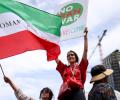
China and Russia on Sunday strongly condemned the United States air strikes on Iranian nuclear facilities, with China calling it a serious violation of the United Nations Charter that heightens tensions in West Asia, and Russia terming the strikes 'irresponsible' and asserting that they grossly violate international law, the UN Charter, and UN Security Council resolutions.

'IT companies do not have a large presence there either in terms of market and team. So, the impact of the war will be minimal. But West Asia is an emerging economy.'

A year after a Hamas attack against Israel on October 7 and the ensuing Israeli invasion of the Gaza Strip, India's trade with most West Asian countries has largely escaped any major disruption, except with countries like Israel, Lebanon, and Jordan. However, repeated flare-ups of geopolitical tensions in the region continue to drive up shipping and logistics costs.

During a bilateral lunch with the Ukrainian President in the White House, Trump reiterated his confidence in facilitating an end to the ongoing war.
